Museums and cultural institutions are places for discovery, learning and enjoyment. Yet, for people with intellectual disabilities, barriers to accessibility and participation can make these experiences difficult to enjoy. INCLUDE-ID, a four-year European research and innovation project, aims to change this by bringing together cultural institutions, researchers, families and people with intellectual disabilities to develop more inclusive cultural experiences, supported by digital innovation and artificial intelligence.
At the heart of this ambition lies a simple principle: inclusion is not simply about making experiences accessible. It is also about giving people a meaningful role in shaping them. And that process should begin long before new solutions are developed or tested.
The first opportunity came with the project's visual identity.
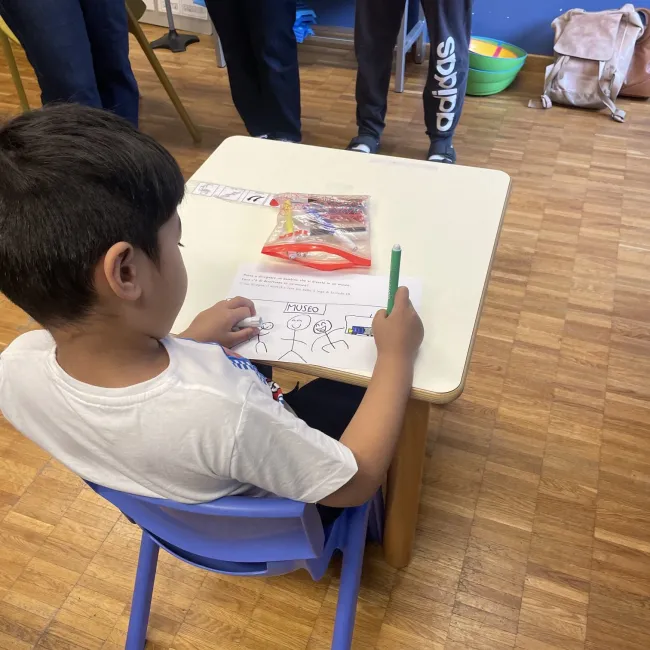
On 06 October 2026, L'abilità, with the support of IRCCS Eugenio Medea, convened two small groups of primary school children with intellectual disabilities at its premises in Milan. The two sessions, each lasting approximately one hour, were designed to encourage participation through accessible and familiar activities.
The children were first introduced to INCLUDE-ID and the world of museums through a short story. They then shared their experiences of visiting museums, discussed what makes these places enjoyable and explored two different concepts for the project's logo.
The initial conversation offered an encouraging starting point: all seven children recalled positive experiences in museums and agreed that museums can be places to have fun.
But what did they make of the proposed designs?
The results revealed an important distinction between visual appeal and accessibility. All seven children preferred the first logo, recognising in its symbol people coming together and having fun. The second symbol proved more difficult to interpret. Yet, when it came to the lettering, the preference was reversed: the children found the typography of the second concept easier to read. The colours received positive feedback across both groups.
These findings are now informing the final design. The graphic designers are taking forward the children's preferred symbol, combining it with the more legible lettering of the second concept and retaining the colours that received positive feedback. The choices made by the children are therefore not simply observations collected during a consultation: they are becoming part of the project's visual identity.
The sessions concluded with a creative exercise. Each child was invited to draw how they imagined a child having fun in a museum. These drawings provide further inspiration for the development of the visual identity.
Parents were also invited to contribute through a questionnaire. The two responses available when the activity report was prepared expressed positive views on both concepts, without a clear preference between them.
To be sure, the findings are qualitative and come from a small group of seven children. They cannot be taken as representative of all people with intellectual disabilities. Their value lies in providing direct insights into how children interpret visual elements that designers and other adults might otherwise take for granted.
This first activity illustrates a wider ambition of INCLUDE-ID. Making cultural institutions more inclusive is not simply a question of introducing new technologies or removing barriers. It also requires rethinking how experiences are designed, whose perspectives inform decisions and how people with intellectual disabilities can contribute to shaping cultural life.
Ownership begins when participation makes a difference. For INCLUDE-ID, that means ensuring that the perspectives of people with intellectual disabilities are not only heard, but reflected in the choices that shape the project. Starting with something as simple as a logo is a small but concrete step in that direction.
The final INCLUDE-ID visual identity will be unveiled soon on the project's website and social media channels.